



After testing tools used by agencies of all sizes, I found the 10 best insurance agency software platforms that handle policy management, client communication, and day-to-day agency operations in 2026.
10 Best insurance agency software: At a glance
Insurance agency software helps you manage policies, service clients, handle renewals, and keep your agency running efficiently. Let’s compare the 10 best tools side by side:
| Tool | Best for | Monthly price | Key strength |
|---|---|---|---|
| Applied Epic | Large and enterprise agencies | Custom pricing | Deep carrier integrations |
| AMS360 | Mid-sized independent agencies | Custom pricing | Built-in accounting and reporting |
| HawkSoft | Independent insurance agencies | Custom pricing | Ease of use and responsive support |
| Momentum by NowCerts | Small independent insurance agencies | $99/month | Affordable policy management with built-in document storage and reporting |
| Assembly | Agencies using an AMS that want a branded client portal | $49/month | Branded client portals with CRM, billing, messaging, and file sharing |
| QQCatalyst | Independent agencies in the Vertafore ecosystem | Custom pricing | Native integration within the Vertafore ecosystem |
| AgencyZoom | Sales pipeline and renewals | $149/month for independent agencies | Insurance-native sales automation |
| GloveBoxCRM | Insurance CRM and client follow-up | $499/month | Pre-built automated campaigns |
| EZLynx | Comparative rating | Custom pricing | Multi-carrier quoting tools |
| ePayPolicy | Premium payment collection | $25/month | Insurance-focused payment processing |
1. Applied Epic: Best for large and enterprise agencies
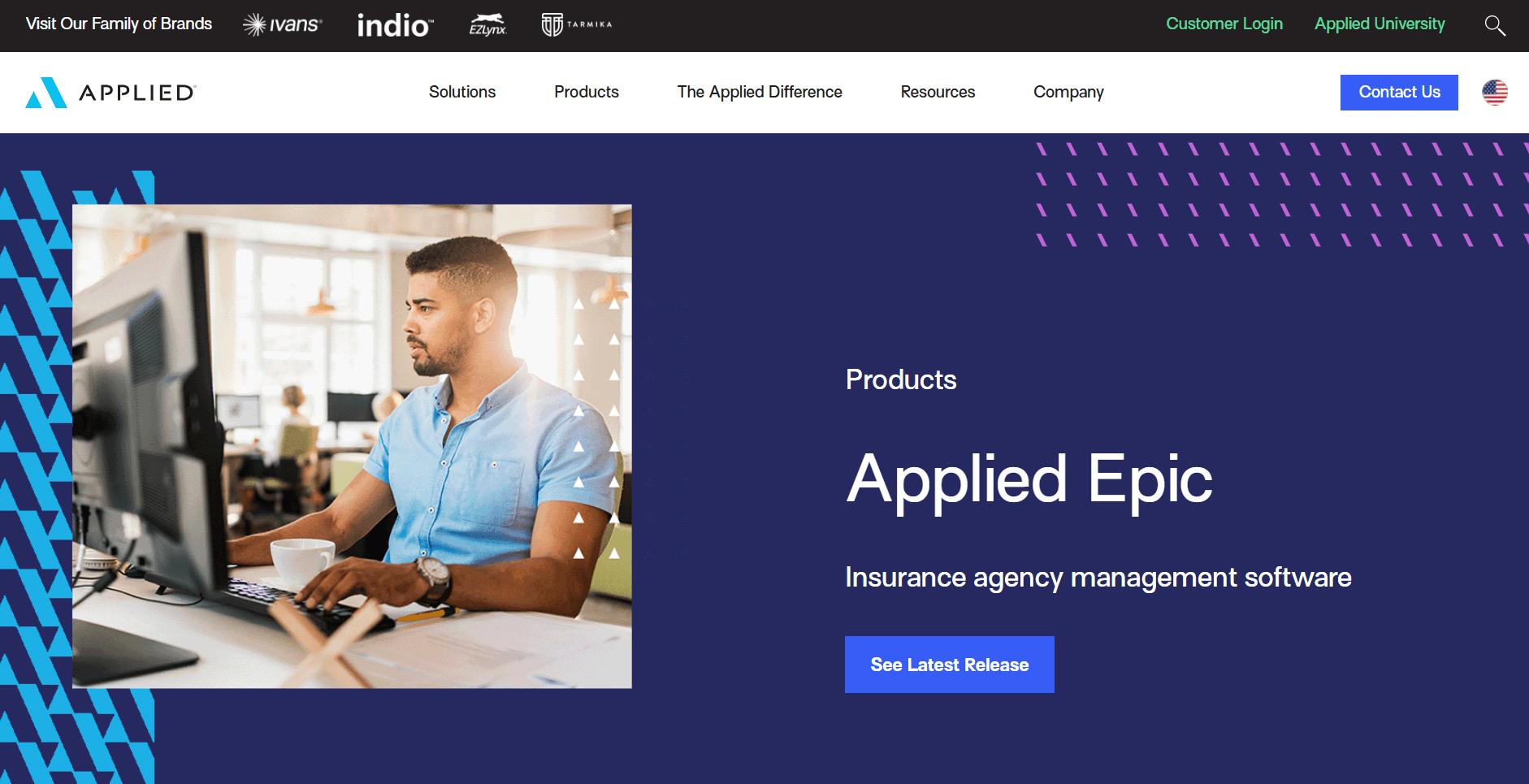
- What it does: Applied Epic is an agency management system (AMS) with both desktop and browser-based interfaces. It handles policy administration, carrier connectivity, accounting, and reporting. It covers both property and casualty (P&C) and benefits lines of business, giving agencies a single view of every client and workflow across all locations and roles.
- Who it's for: Mid-size to enterprise independent agencies that need one platform to manage their full book of business.
I tested the demo of Applied Epic to see how it handles agency workflows. The carrier connectivity was the clearest differentiator, letting agents access markets, exchange policy data, and retrieve carrier information directly within the AMS.
The role-based dashboards give producers, customer service representatives (CSRs), and managers a tailored view of their work. Built-in accounting is another differentiator, since many AMS platforms offload that to a separate tool entirely.
That said, I found that routine tasks like endorsements require more clicks than expected, and attachments can't be dragged out of the system without re-saving locally.
Key features
- Carrier connectivity: Agents can access markets and exchange policy data with insurers directly from within the AMS workflow.
- Role-based dashboards: Each team member sees a view tailored to their function, from producer pipelines to CSR task queues.
- Integrated accounting: Financial reporting, commission tracking, and accounting workflows are built into the platform.
Pros
- Covers P&C and benefits in one system
- Carrier integrations reduce manual data entry
- Browser-based access works across devices and locations
Cons
- Email workflows can be more limited than working directly from Outlook, particularly around formatting and signatures
- Data entry errors can be difficult to correct once saved
Pricing
Applied Epic uses custom pricing.
Bottom line
Applied Epic is worth considering for agencies managing both P&C and benefits lines that need direct carrier access built into their AMS. If you mainly sell personal lines coverage, HawkSoft might be a better fit.
2. AMS360: Best for mid-sized independent agencies
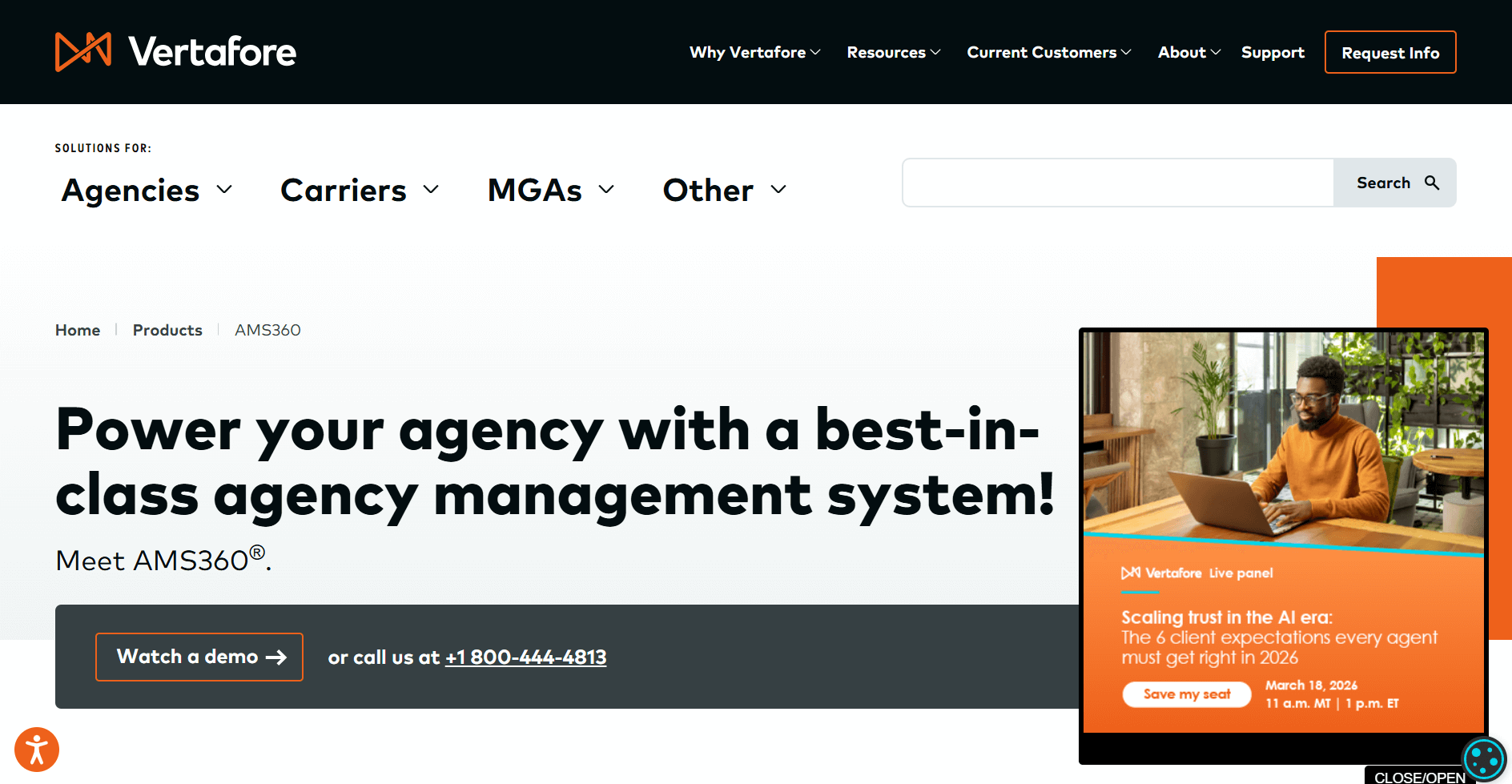
- What it does: AMS360 is a cloud-based agency management system from Vertafore that handles policy tracking, renewals, commission accounting, and reporting. It covers both personal and commercial lines and connects agency and carrier workflows in one place.
- Who it's for: Mid-sized independent agencies that want built-in accounting and financial reporting without relying on a separate tool.
I went through a demo walkthrough of AMS360 to evaluate how it handles agency accounting. The depth here goes beyond what you'd find in a general-purpose AMS. The system automatically calculates commission splits. It also handles trust accounting and runs financial reports without necessarily relying on a QuickBooks export.
The reporting module lets managers see production, retention, and agency finances in one place. This helps teams track performance without needing to pull data from different sources. The Vertafore ecosystem also works in AMS360's favor if your agency already runs other Vertafore products.
I found that pulling accurate reports took more setup than expected, since the system depends on clean data entry upfront.
Key features
- Insurance-specific accounting: Commission tracking, trust accounting, and financial reporting are built directly into the platform.
- Renewal and retention tools: Automated alerts notify your team of upcoming renewals and rate changes before they slip through.
- API library: Connects with third-party tools including ePayPolicy, DocuSign, and other Vertafore products.
Pros
- Tracks commissions down to the policy level without a separate accounting tool
- Covers both personal and commercial lines in one system
- Browser-based access works across locations and devices
Cons
- Reporting accuracy depends on consistent data entry practices across the whole team
- Email and letter workflows are largely built around Microsoft tools, limiting flexibility for agencies outside that ecosystem
Pricing
AMS360 uses custom pricing.
Bottom line
AMS360 is a strong fit for agencies that want insurance-specific accounting and commission tracking built into their core system. If your agency's main focus is sales pipeline and renewal tracking rather than accounting depth, AgencyZoom might be a better fit.
3. HawkSoft: Best for independent insurance agencies
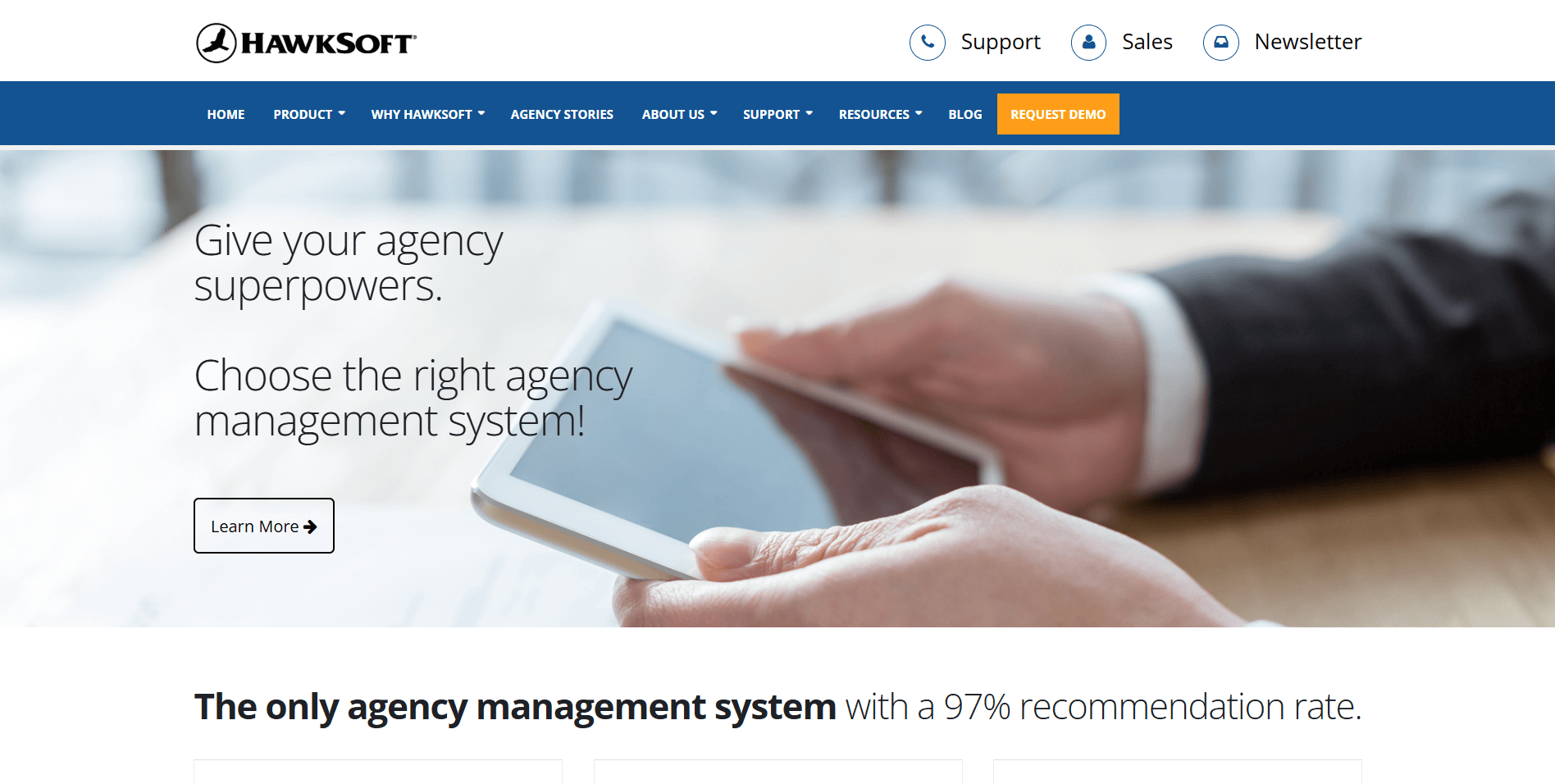
- What it does: HawkSoft is an agency management system built for independent insurance agencies. It covers policy management, client tracking, commission accounting, and retention reporting in one platform.
- Who it’s for: Independent agencies that value operational independence and clear ownership over their policy and client data.
During my demo walkthrough, I noticed HawkSoft builds its workflows around independent agency operations. The Agency Intelligence reporting suite covers retention, cross-sell opportunities, and sales pipeline in one view. This gives agency owners a practical snapshot of their book without manually pulling data from multiple places.
HawkSoft handles trust accounting and commission tracking natively, with many agencies managing operating accounting through a QuickBooks integration. I also noticed that the Hot Buttons feature lets staff reduce repetitive steps on common tasks like endorsements and certificates.
Tailoring workflows or building reports outside the standard templates took more effort than I expected.
Key features
- Agency Intelligence reporting: Tracks retention, cross-sell opportunities, and sales pipeline KPIs from one dashboard.
- Native trust accounting: Handles insurance-specific commission tracking and end-of-day payment reports within the platform.
- Uprate Alerts: Notifies staff when client premiums are increasing ahead of renewal so they can reach out proactively.
Pros
- Built by independent agents, so workflows reflect how agencies actually operate
- No lock-in contracts and agencies retain full ownership of their data
- Responsive customer support with consistently high ratings across review platforms
Cons
- Workflow customization is limited outside of standard templates
- Some users report periodic connectivity issues that can take the system offline without warning
Pricing
HawkSoft uses custom pricing.
Bottom line
HawkSoft's no-contract model and agency-owned data policy set it apart from most AMS platforms, where switching costs can be significant. If your agency manages both P&C and benefits lines and needs deeper carrier connectivity, Applied Epic might be a better fit.
4. Momentum: Best for small independent insurance agencies
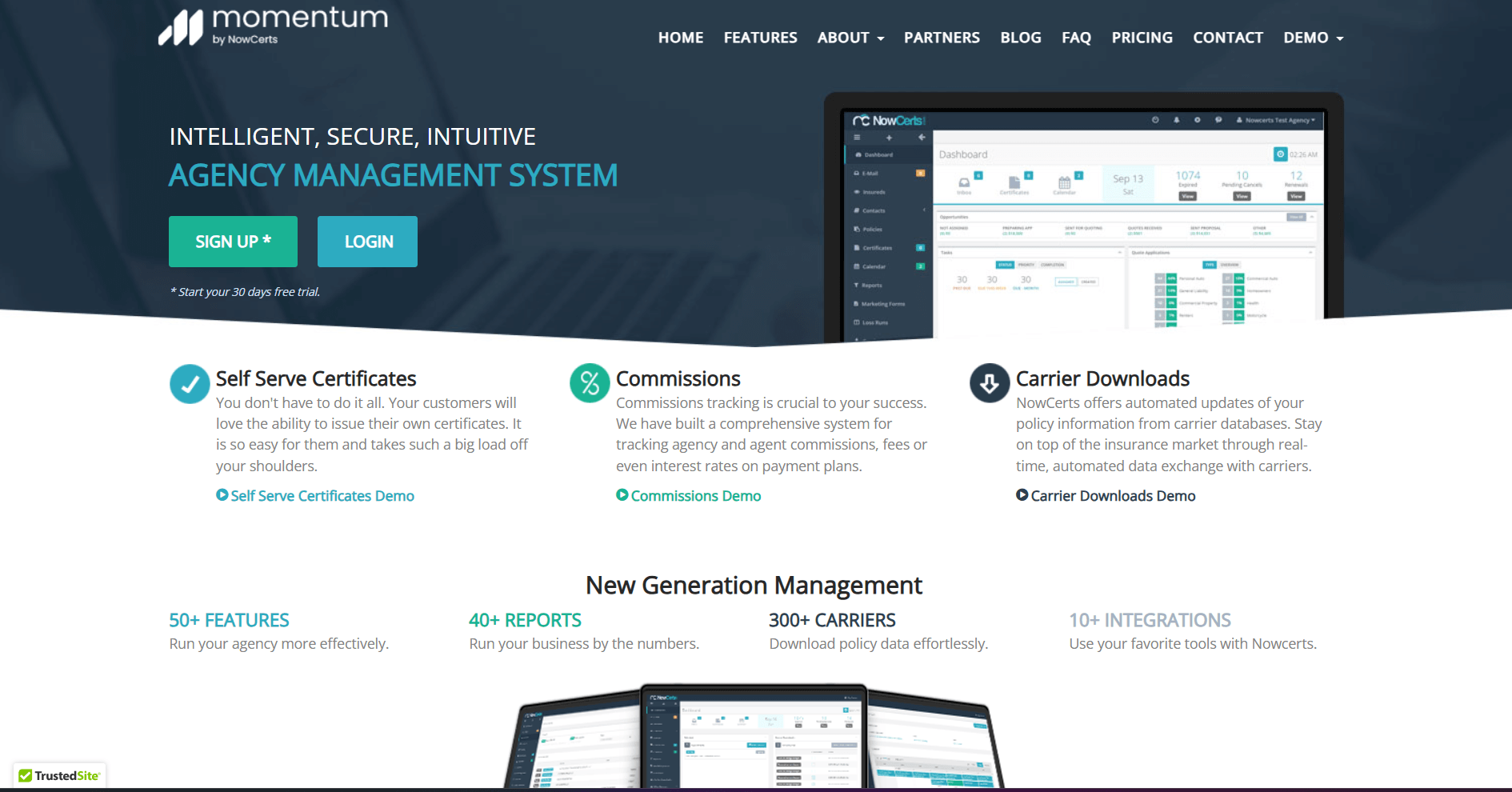
- What it does: Momentum (by NowCerts) is a cloud-based agency management system. It handles policy management, document storage, ACORD forms, commission tracking, and reporting in one platform. It also connects with personal and commercial lines raters, CRMs like AgencyZoom, and payment processors like ePayPolicy through an open API.
- Who it's for: Small independent agencies that need a full AMS at a lower price point than enterprise platforms.
I tested Momentum by working through the policy management and reporting workflows to see how it handles core agency operations.
The interface takes some getting used to, since frequently used areas are buried a few clicks deep. Once you learn where things live, the workflow makes sense. However, I found the initial learning curve is steeper than platforms like HawkSoft.
The pricing structure stood out because core features are available across all tiers, so entry-level users aren’t locked out of key functionality.
During testing, I noticed slower load times on tasks like generating certificates of insurance (COI). This can create a bottleneck during busy periods if COI volume is high at your agency.
Key features
- Policy management: Tracks policy details, endorsements, and renewals, with carrier data integrations that help keep policy information current.
- Document storage and ACORD forms: Stores client documents and generates ACORD forms in PDF and HTML formats directly from policy records.
- Open API and integrations: Connects with raters, CRMs, payment processors, and VOIPs through direct integrations and Zapier.
Pros
- Carrier integration reduces the need for manual policy data entry.
- Complimentary onboarding and training included with all plans
- Commission tracking covers agency commissions, agent commissions, fees, and payment plan interest rates
Cons
- Navigation layout is layered and can be difficult to work through for new users
- System load times can slow down under heavier usage
Pricing
Momentum starts at $99 per month.
Bottom line
Momentum is a reasonable starting point for agencies that need structured policy and document management. Agencies that want a more established AMS with a longer track record might find HawkSoft worth a look.
5. Assembly: Best for agencies using an AMS that want a branded client portal
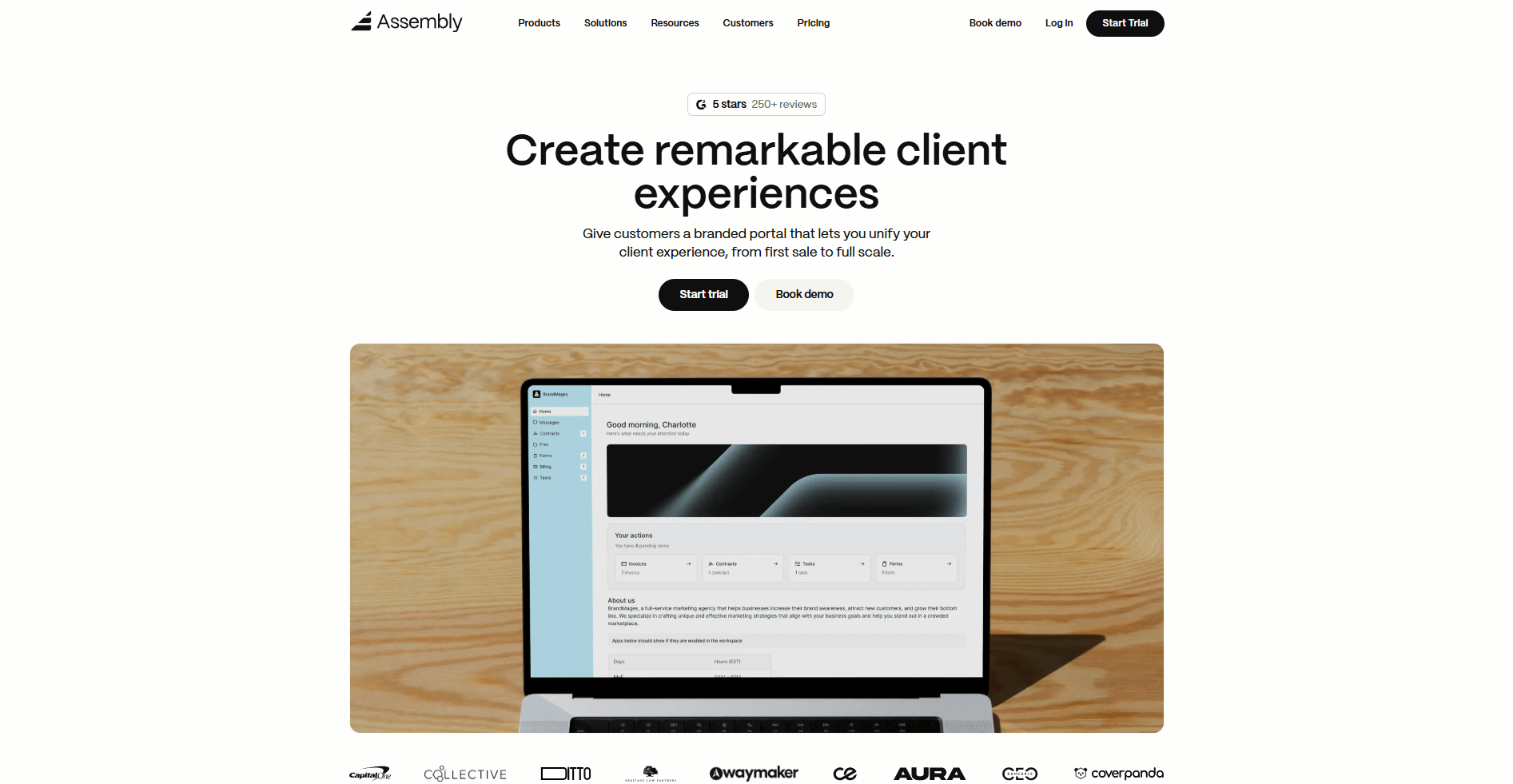
- What it does: Assembly is a branded client portal and CRM built for insurance agencies and other service businesses. It gives agencies a dedicated space where clients can access invoices, files, contracts, messages, and task updates under your agency's branding.
- Who it's for: Insurance agencies using an AMS that want to give clients a professional, branded experience without adding more disconnected tools.
We built Assembly to give insurance agencies a client-facing layer that many AMS platforms don't provide on their own. Day-to-day client communication often runs through scattered emails and carrier apps that carry someone else's branding. Assembly allows you to give each client their own portal login tied to your agency's domain instead.
Once they log in, clients can upload files, send messages, view invoices, sign contracts, and check task progress without calling your office. You control what each client sees, so the experience stays relevant and organized across your book of business.
If your team spends time before calls digging through past emails and notes, our AI Assembly Assistant surfaces client history, recent activity, and key details in one place so you can walk in prepared.
You can connect Assembly with Zapier and Make to tie portal activity into broader workflows. You can also use the Assembly App Store to embed tools like Calendly, Google Drive, and Airtable directly into the client portal.
Key features
- Branded client portal: A dedicated login for each client under your agency's domain, with access to files, invoices, contracts, messages, and tasks.
- Security and compliance: Assembly maintains SOC 2 compliance and supports HIPAA-compliant deployment, along with GDPR and CCPA requirements.
- Messaging App: A secure, branded channel for client communication that keeps conversation history tied to each client record, off email.
- Files App: Share and store policy documents, onboarding materials, and client files in an organized portal space under your agency's brand.
- Assembly Assistant: Surfaces client notes, history, and recent activity to give your team context before client interactions.
Pros
- Clients interact with your agency through your brand, not a carrier app or generic portal
- Communication, files, and tasks all connect to the same client record, so your team has full context without switching between tools
- Works alongside your existing AMS rather than replacing it
Cons
- Built for ongoing client relationship management, so it's less suited for agencies that primarily handle transactional, one-time policy sales
- Purpose-built for the client experience layer, so policy management and carrier data still live in your AMS
Pricing
Assembly has a free plan, and paid plans start at $29 per month billed annually, or $49 billed monthly.
Bottom line
Assembly lets you give clients a dedicated portal so they stay engaged with your agency after the sale. If your priority is comparative rating and multi-carrier quoting, EZLynx might be a better fit.
6. QQCatalyst: Best for independent agencies in the Vertafore ecosystem
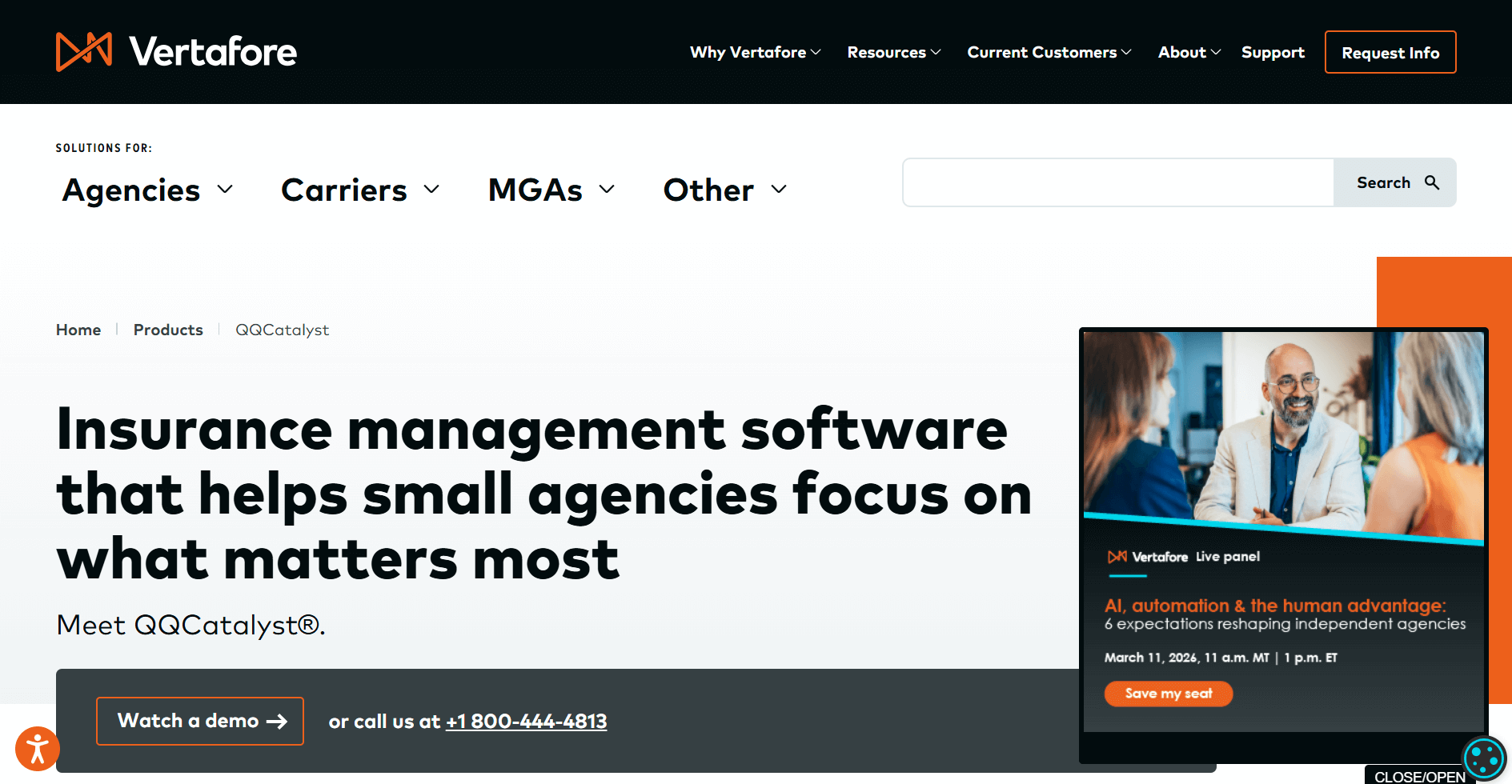
- What it does: QQCatalyst is a cloud-based agency management system. It handles policy and client management, sales pipeline tracking, marketing automation, and document storage. It integrates natively with other Vertafore products, including PL Rating and AgencyZoom, and connects with QuickBooks for basic accounting.
- Who it's for: Independent agencies already using Vertafore tools that want an AMS with built-in sales and marketing automation.
I watched QQCatalyst's recorded demo and reviewed the platform documentation to understand how it handles day-to-day agency operations. The two-way data sync with AgencyZoom and PL Rating reduces the need to re-enter data across systems if your agency already runs on Vertafore products.
The platform works best for personal lines and small commercial agencies. I found the commercial lines functionality more limited compared to larger AMS platforms, particularly for agencies handling mid-market commercial accounts. Agencies with a heavy commercial book may find themselves working around those gaps more than expected.
Key features
- Smartflows automation: Builds automated client journeys for onboarding, cross-selling, and renewals using trigger-based workflows tied to policy events.
- Vertafore ecosystem integrations: Connects natively with AgencyZoom and PL Rating for two-way data sync across sales, rating, and policy management.
- Sales pipeline management: Tracks new business, renewals, and rewrites by close date with team productivity reporting built in.
Pros
- Out-of-the-box setup with no lengthy implementation process
- Cloud-based with mobile access, so your team can pull up client records and send documents from anywhere
- Built-in texting logs client messages directly to their file, helping maintain a documented communication trail
Cons
- Limited built-in invoicing, so agencies often rely on QuickBooks or another accounting tool
- Commercial lines support is more limited than larger AMS platforms, particularly for mid-market accounts
Pricing
QQCatalyst offers custom pricing.
Bottom line
QQCatalyst fits agencies already running Vertafore tools, where the native integrations do the heavy lifting. For agencies that need built-in accounting rather than a QuickBooks connection, AMS360 might be worth a look.
7. AgencyZoom: Best for sales pipeline and renewals
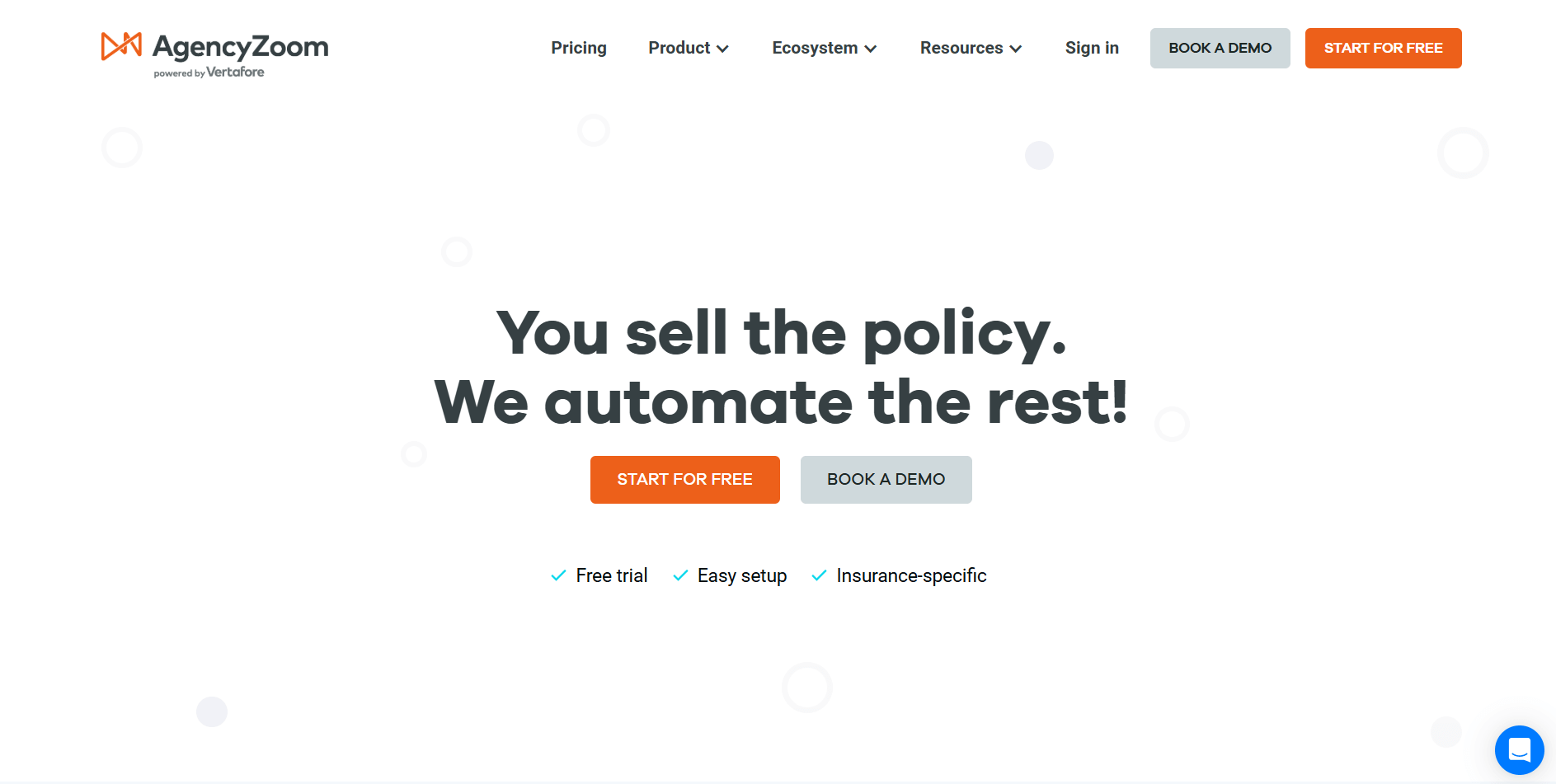
- What it does: AgencyZoom is an insurance-native CRM owned by Vertafore (the same company behind AMS360). It focuses on sales pipeline management, client onboarding automation, and policy renewal tracking. It also integrates with many AMS platforms and adds a sales and retention layer on top of them.
- Who it's for: Independent insurance agencies that want to automate prospecting, follow-ups, and renewal outreach without replacing their existing AMS.
AgencyZoom is built for insurance sales and I tested it by working through its renewal automation workflows and core pipeline features. You set up automated email and text sequences that can trigger based on policy dates synced from your AMS. That way, your team reaches out to clients before renewal without manually tracking every expiration.
I found that the onboarding automation follows a similar logic. When a new client signs on, you can trigger a structured welcome sequence that moves them through touchpoints without staff chasing each step. Two-way texting and email keep communication history alongside deal records, and the Google Reviews feature lets you request reviews automatically after positive interactions.
The one thing worth knowing upfront is that AgencyZoom is entirely an internal tool, so clients don’t have a login or dashboard. Service activity is initiated through email and handled inside the system by your team.
Key features
- Renewal automation: Set up automated outreach sequences triggered by policy renewal dates from your AMS.
- Two-way texting and email: Send and receive client messages directly in AgencyZoom.
- AMS integration: Connect with most major management systems like AMS360, HawkSoft, and EZLynx.
Pros
- The 14-day free trial lets you test the full feature set before committing to a plan
- Insurance-native design means pipelines, automations, and reporting reflect how agencies work
- Keeps all client communication in one place
Cons
- No client-facing portal or self-service access
- Reporting and goal-tracking dashboards lack the customization some agencies need for non-standard KPIs
Pricing
AgencyZoom starts at $149 per month for independent agencies.
Bottom line
If renewal season is where your agency loses the most clients, AgencyZoom's automation cuts through the manual follow-up that lets policies quietly lapse. If giving clients a self-service portal and a more professional post-sale experience is the priority, Assembly might be a better fit alongside your AMS.
8. GloveBoxCRM: Best for insurance CRM and client follow-up
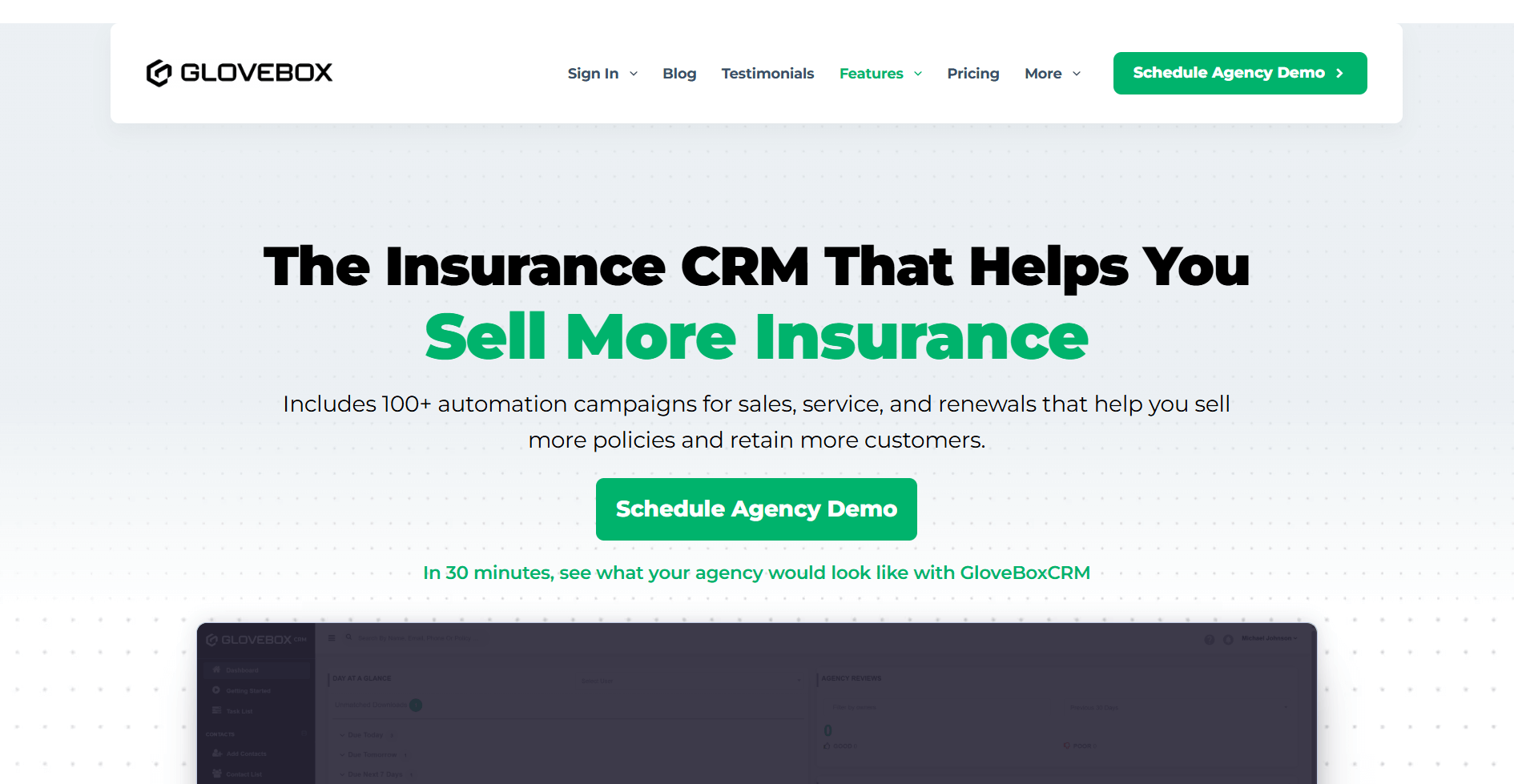
- What it does: GloveBoxCRM (formerly Better Agency) is an insurance-specific CRM that gives clients a branded mobile app and web portal to access policy documents, request changes, and access billing info. It connects with major AMS platforms and layers a client-facing experience on top of your existing system.
- Who it's for: Independent insurance agencies that want to reduce inbound service calls by giving clients self-service access to their policies.
GloveBoxCRM is built around one idea: clients shouldn't need to call your agency for routine requests. During the demo, I found that the branded mobile app gives clients access to ID cards, policy documents, service requests, and quotes under your agency's branding.
Another thing that stood out during the demo was the pre-built automated campaigns. You can run cross-sell sequences, renewal touchpoints, and referral requests without building workflows from scratch. If you want automation without a lot of configuration time, that's an advantage over tools that require more manual setup.
I also noticed that data reliability can be a sticking point. If client contact information in your AMS doesn't match what the client uses to log in, policy documents may not appear correctly on their end.
Key features
- Branded client app: Clients access policy documents, ID cards, and billing through a mobile app and web portal under your agency's brand.
- Pre-built automated campaigns: Run cross-sell, renewal, and referral sequences using templates built specifically for insurance agencies.
- AMS integrations: Connects with major platforms including Applied Epic, AMS360, HawkSoft, EZLynx, and others.
Pros
- Client-facing app reduces inbound service volume, freeing up CSR time for higher-value work
- Insurance-specific campaign templates mean less setup time
- Connects with major AMS platforms
Cons
- Workflow and reporting customization is limited
- AMS sync delays can cause policy data to appear outdated or incomplete on the client side until the next import runs
Pricing
GloveBoxCRM starts at $499 per month.
Bottom line
GloveBoxCRM works best when your main goal is reducing inbound service calls through client self-service. Agencies that need a broader post-sale client experience with billing, contracts, and messaging in one branded portal might find Assembly a better fit.
9. EZLynx: Best for comparative rating
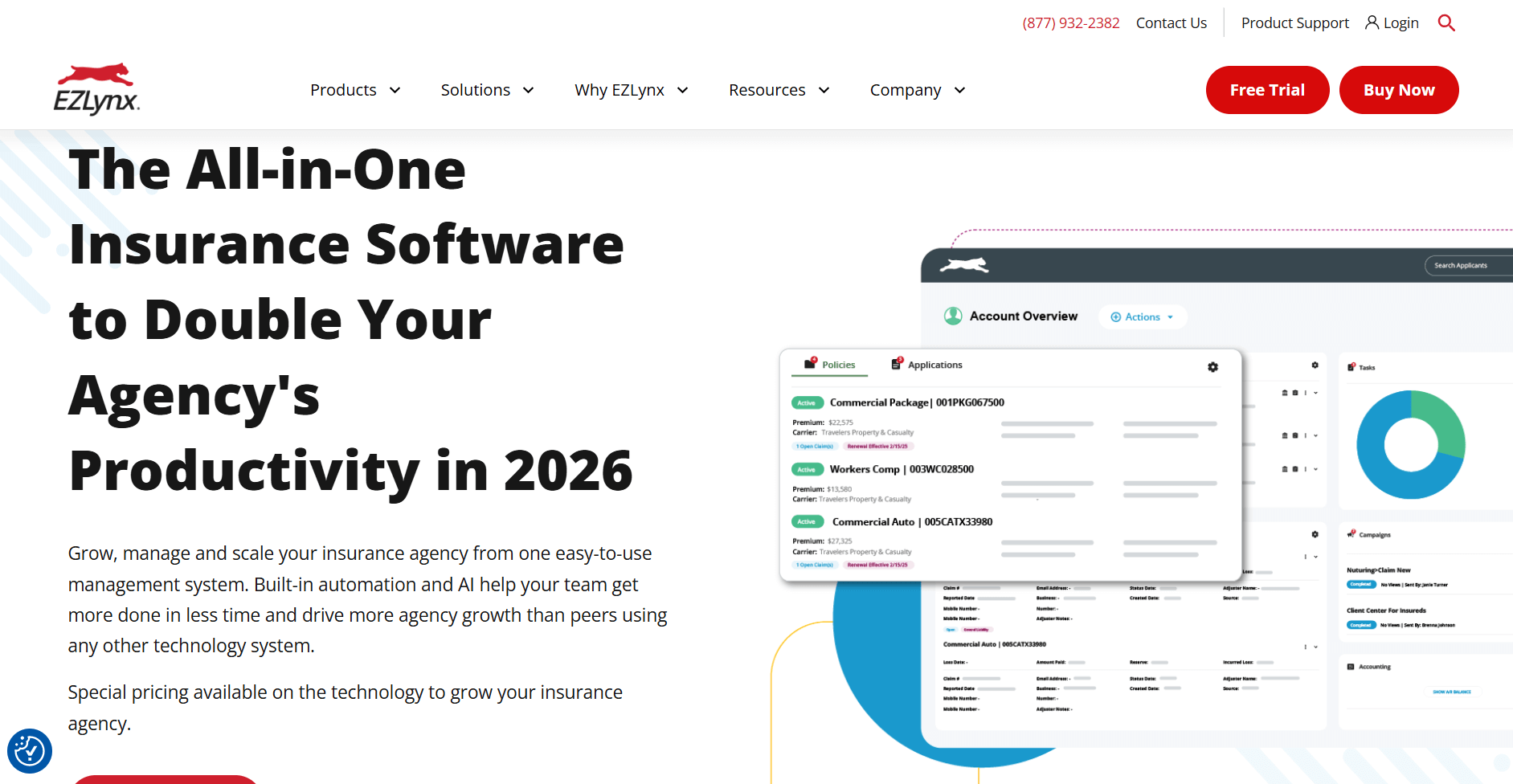
- What it does: EZLynx is an insurance agency management system built around a comparative rating engine. It lets agents enter applicant data once and pull real-time personal lines quotes from over 330 carriers across 48 states. It also has separate commercial lines submission tools available within the broader platform.
- Who it's for: Independent insurance agencies that need a high-volume personal lines quoting tool with built-in agency management and retention features.
EZLynx is now part of Applied Systems, the same parent company behind Applied Epic. I tested EZLynx by running sample personal lines quotes through the rating workflow. You enter applicant data once and the system returns quotes from multiple carriers side by side, reducing the need to visit individual carrier portals.
Beyond quoting, the Retention Center lets you identify at-risk renewals using predictive analytics. That way, your team can prioritize outreach before clients start shopping elsewhere. Policy Compare adds a side-by-side breakdown of expiring and renewing policies, which helps agents walk clients through premium changes at renewal.
I found that not every carrier is fully supported, and quote accuracy can vary by carrier and state. Some third-party AMS integrations also require additional fees.
Key features
- Rating Engine: A single-entry comparative rater that returns real-time personal lines quotes from over 330 carriers across 48 states.
- Retention Center: A predictive analytics tool that identifies at-risk renewals and sorts them by likelihood of lapse.
- Policy Compare: A side-by-side view of expiring and renewing policies that highlights coverage changes and premium differences.
Pros
- Single-entry quoting across hundreds of carriers removes the need to re-enter data into each carrier portal
- Used by over tens of thousands of agencies, so carrier connections and workflows are well established
- Covers both personal and commercial lines from one platform
Cons
- Carrier coverage has gaps, and quote accuracy can vary by carrier and state
- Some integrations with third-party AMS platforms require additional fees, which add to the overall cost
Pricing
EZLynx uses custom pricing.
Bottom line
EZLynx is built for high quoting volume. The single-entry rating workflow saves time by reducing carrier portal hopping. If you care more about sales tracking and renewals, AgencyZoom might be a better fit.
10. ePayPolicy: Best for premium payment collection
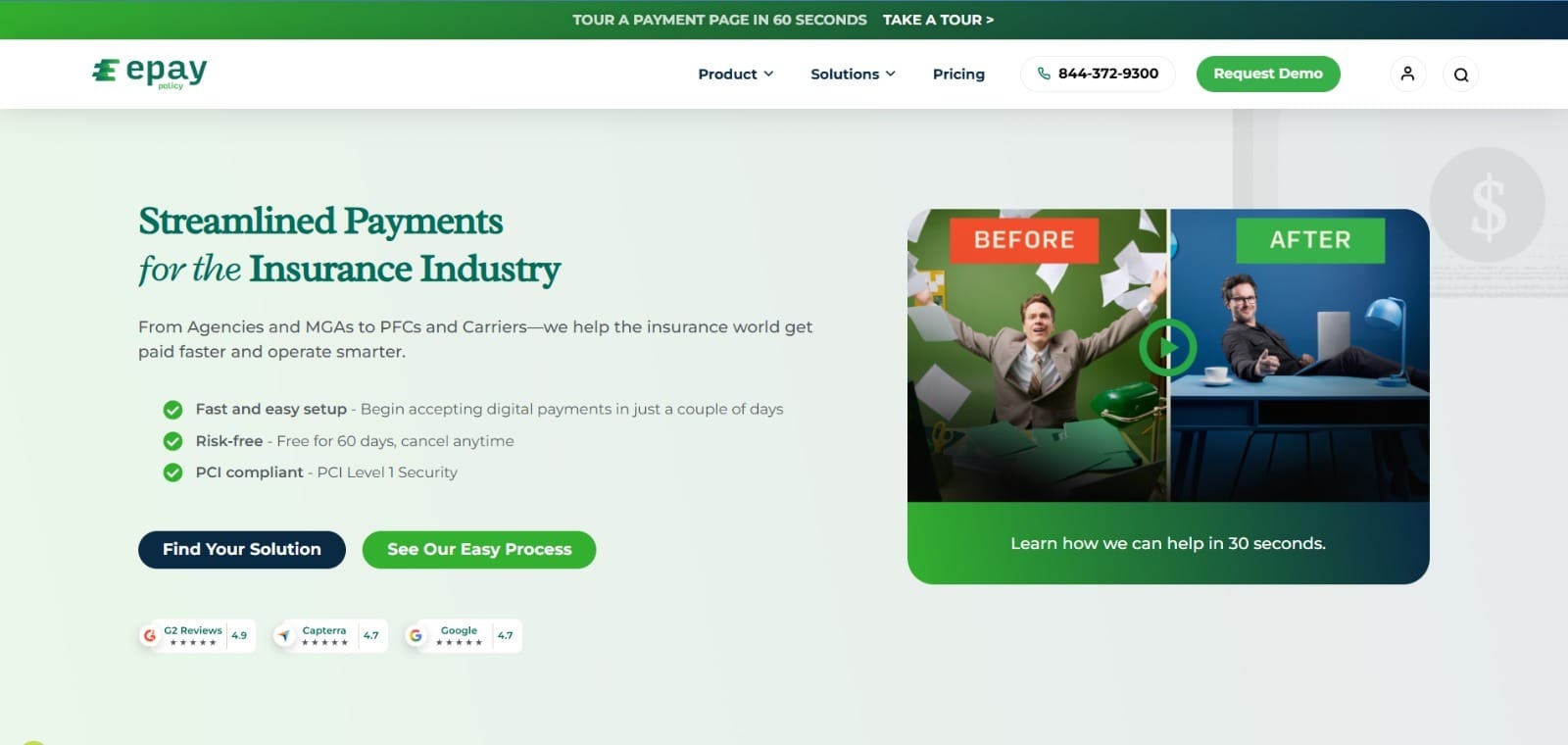
- What it does: ePayPolicy is an insurance-specific payment processing platform that lets agencies collect premiums online via ACH and credit card. It offers a branded payment page for clients and integrates with dozens of leading agency management and accounting systems.
- Who it's for: Independent agencies, managing general agents (MGAs), and brokers that want to replace paper checks and manual payment collection with a digital process built for insurance.
I tested ePayPolicy by setting up a sample branded payment page. From the client side, the payment experience looks like it belongs to your agency rather than a third-party processor. This matters because clients who see an unfamiliar payment portal may hesitate before completing a transaction.
The AMS integrations are where ePayPolicy earns its place in an agency's stack. Connecting to a system like Applied Epic or HawkSoft allows payment records to sync back into your management system, reducing manual entry and lowering the risk of accounting errors.
The fee structure is worth understanding before rollout. ePayPolicy passes transaction fees to the insured by default. You can choose to absorb them, but some clients may push back on paying the fees directly.
Key features
- Branded payment page: A customizable page with your agency's logo and colors, linked to a unique URL you share across client communications.
- AMS integrations: Connects with many management systems including Applied Epic, AMS360, HawkSoft, and EZLynx for payment reconciliation.
- Finance Connect: A premium financing option at checkout that clients can select to split large premiums without a separate conversation.
Pros
- Insurance-native AMS integrations reduce manual reconciliation work
- PCI Level 1 compliant, with industry-standard secure payment processing
- 60-day free trial with no setup fees
Cons
- ACH return notifications are not immediate, so failed payments can go unnoticed until the next review
- Same-day deposits sometimes arrive as split batches, which complicates daily reconciliation
Pricing
ePayPolicy starts at $25 per month.
Bottom line
ePayPolicy works well for agencies that need payment infrastructure built around how insurance billing works, with AMS sync and insurance-specific compliance baked in rather than bolted on. If quoting is the bigger gap in your workflow, EZLynx might be worth a look for its multi-carrier rating tools.
How I tested these insurance agency software tools
I tested each tool by working through core agency workflows. When direct access wasn't available, I went through guided walkthroughs, recorded demos, and training documentation to understand how the platforms work in practice.
Here's what I paid attention to:
- Core workflow depth: Does the tool handle the task it's built for, or does it rely on workarounds and third-party add-ons for basic functions?
- Integration reliability: I looked at how well each platform connects with the rest of a typical agency stack, particularly AMS integrations, carrier connections, and accounting tools.
- Client-facing experience: Many AMS platforms are built for internal operations. I paid attention to what the client actually sees, and whether there's any branded experience on their end.
- Persistent limitations: I noted issues that show up consistently across agencies, not just edge cases.
- Pricing and scalability: I reviewed pricing models, contract requirements, and how costs scale as agencies add users, carriers, and workflows.
Which insurance agency software should you choose?
The right insurance agency software tool depends on your agency size, how you manage your book of business, and where your biggest operational gaps are.
Choose:
- Applied Epic if you run a large or enterprise agency that needs deep carrier integrations and can support a full implementation process.
- AMS360 if you’re a mid-sized independent agency that wants built-in accounting and reporting alongside policy management.
- HawkSoft if ease of use and responsive support matter just as much as feature depth.
- Momentum if you’re a small independent agency looking for a full AMS at a lower entry price.
- QQCatalyst if you already use Vertafore products and want tighter integration across your existing stack.
- AgencyZoom if sales pipeline visibility and renewal automation are the biggest gaps in your workflow.
- Assembly if you already have an AMS and want a branded client portal to manage the ongoing client relationship.
- GloveBoxCRM if your main goal is reducing inbound service calls through client self-service.
- EZLynx if comparative rating sits at the center of your daily quoting workflow.
- ePayPolicy if you want to move away from paper checks and collect premiums online through an insurance-specific payment system.
If your agency's workflow doesn't fit an off-the-shelf tool, you can build custom apps for business around the way your team already works.
My final verdict
I found that Applied Epic and AMS360 are built for agencies that prioritize policy infrastructure above everything else. AgencyZoom handles pipeline and renewals well, and GloveBoxCRM gives clients a self-service app for routine requests. However, the post-sale relationship side of the stack is still something many agencies have to piece together.
Assembly isn’t a traditional agency management system, it’s the client-facing layer that many AMS platforms don’t provide. You get a branded portal for documents, billing, and communication that sits on top of your existing AMS. This helps agencies that already have their operations covered and want a more structured way to manage what clients actually see and interact with.
Want to add a client portal to your agency software stack? Try Assembly
Many insurance agency software platforms focus on internal operations. They don't always provide a complete workspace for managing the ongoing client relationship.
Assembly is client portal software built on a core CRM with billing, secure messaging, and file sharing in one place. Insurance agencies can fully white-label the portal under their own domain, so clients log into the agency’s branded workspace instead of a carrier site or third-party app.
Here’s what you can do with Assembly:
- Track client details and activity: Manage client records, communication history, and relationship data in a structured CRM that keeps everything organized in one place.
- Give clients a branded portal: Clients log into a space that reflects your brand to access contracts, invoices, files, and project updates without email back-and-forth.
- Keep tasks, messages, and files together: Client communication, shared files, and project tasks stay connected to each client record instead of being scattered across separate tools.
- Prep faster for meetings: The AI Assistant summarizes recent client activity and communication, helping you walk into calls with a clear picture of what’s been discussed and what’s outstanding.
- Protect client data: Assembly meets SOC 2 compliance standards with role-based permissions, encryption, and regular security audits. It also supports GDPR, CCPA, and HIPAA compliance.
- Cut down on admin: Automate repetitive jobs like reminders, status updates, or follow-up drafts so your team can focus on clients.
Ready to give your clients a better experience outside your AMS? Start your free Assembly trial today.