



The best accounting firm names signal credibility, travel well by word of mouth, and hold up legally. I compiled 1,250+ ideas across 17 categories to help you find one that works.
Legal and online considerations before you choose your accounting firm name
Two things can derail a name before you use it: a legal conflict with an existing business, and a digital footprint that's already claimed by someone else. I’d sort these out before you settle on a name.
Here's what to check:
Check your state's business name availability
Your firm name needs to be available in the state where you plan to register. Most states run a searchable business entity database through the Secretary of State's office, and you can check name availability for free. Keep in mind that if another registered business is using the same name or something similar, your registration could be rejected.
Tip: Some states distinguish between exact matches and "deceptively similar" names, so a slight spelling variation doesn't always protect you. If you plan to operate across multiple states, run the search in each one.
Verify trademark status with the USPTO
State registration doesn't protect you from federal trademark conflicts. You can search existing trademarks through the USPTO's TESS database at no cost. If a name is already trademarked in the accounting or financial services category, using it can expose you to a cease-and-desist letter, even if your state approved the registration.
I’d say this is a step people tend to skip, and it’s one of the most likely to cause legal problems down the line. Trademarked names in professional services can include single words, stylized phrases, and even certain combinations of initials.
Understand CPA firm naming rules in your state
Many states have specific rules about what an accounting or CPA firm can call itself. Some require the firm name to include a licensed CPA's surname. Others restrict the use of words like "group," "associates," or "partners" unless the firm actually has multiple licensed practitioners. A handful of states regulate whether you can use words like "national" or "international" without meeting certain criteria.
Check your state's Board of Accountancy guidelines before you finalize your name. These rules vary widely, and a name that works in one state may not be compliant in another.
Search for an available domain name
Your domain name is your firm's address online, and it's worth treating it like a business asset from day one. Run a domain search before you commit to a firm name.
The .com extension still carries the most credibility for professional services firms, so if the .com version of your preferred name is taken, it's worth reconsidering the name instead of defaulting to a lesser extension. In my experience, this check alone can narrow your shortlist quickly.
Tip: Use Namecheap or Godaddy to check for your domains.
Check social media handle availability
Even if you don’t plan to post on social media regularly, securing your handles early can protect your brand. Search for your preferred name on LinkedIn, Instagram, Facebook, and X before registering for anything. Inconsistent handles across platforms, like @millercpa on LinkedIn but @millercpaofficial on Instagram, can create confusion and dilute your brand over time.
Run a general web search
Do a plain Google search of your preferred name before committing. You're looking for any existing business, blog, person, or organization that's already associated with that name online. A name with strong existing associations in a different field can still create confusion, depending on how prominently the other entity appears in search results.
This step also helps you find any reputational issues tied to a name that wouldn't show up in a trademark or state registration search.
Once your name clears these checks, you'll also choose the software the firm runs on. If Karbon is on your shortlist, this guide to Karbon pricing for accounting firms shows how each plan's cost changes once you add fees and upgrades, and if you’re weighing it against TaxDome, this TaxDome vs Karbon comparison breaks down how the two fit different firms.
How to name your accounting firm in 8 steps
Naming your accounting firm takes more than a brainstorming session. The firms that land on names they're still happy with years later tend to follow a deliberate process. Here are the steps you can follow:
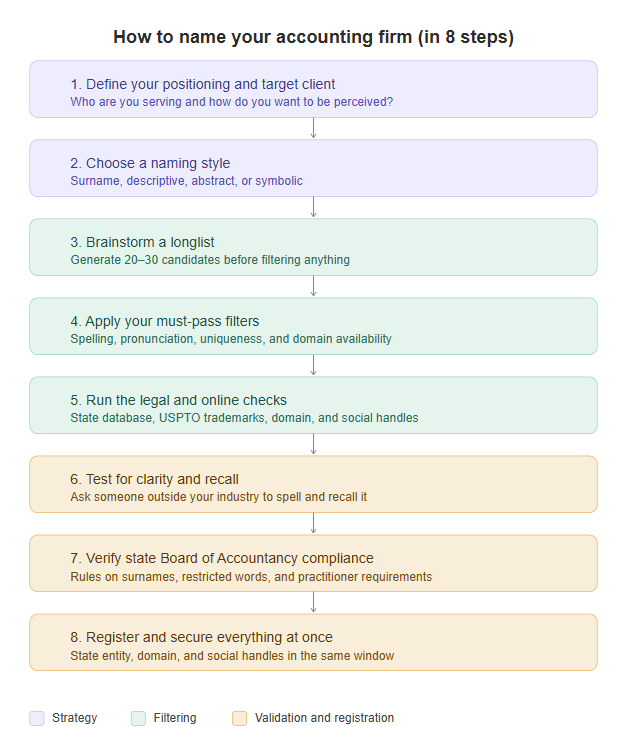
Step 1: Define your positioning and target client
Before you even think of a single name, get clear on who you're serving and how you want to be perceived. A firm targeting small business owners needs a different name than one serving high-net-worth individuals or early-stage startups. Your positioning shapes everything from the tone of your name to the words that you choose.
Ask yourself: what do I want clients to feel when they first hear this name? Established and trustworthy? Approachable and modern? Niche and specialized? The answer narrows your options faster than any brainstorming tool will.
Step 2: Choose a naming style
There are a few broad directions you can take for an accounting firm name, and it helps to pick a lane before generating options. The main styles are:
- Surname-based: Uses the founder's or partners' last names (e.g., "Hartley Accounting" or "Chen and Park CPA")
- Descriptive: Communicates what the firm does or who it serves (e.g., "Startup CFO Group" or "Clarity Tax Advisors")
- Abstract or coined: An invented or conceptual name with no literal meaning (e.g., "Verano Financial" or "Lunara Advisors")
- Symbolic or thematic: Draws on concepts like precision, growth, or trust (e.g., "Meridian Accounting" or "Keystone CPA")
Each style carries different tradeoffs around memorability, scalability, and domain availability. I'd pick one or two styles to explore instead of trying to come up with options across all of them at once.
Step 3: Brainstorm a longlist
Once you have a naming style in mind, brainstorm as many options as you can without filtering. Aim for at least 20 to 30 candidates before you start cutting any. Pull from word associations, industry concepts, geographic references, Latin or classical roots, and anything else that fits your positioning.
Tip: Don't self-edit too early. Some of the best names look strange on a first pass but grow on you once you sit with them.
Step 4: Apply your must-pass filters
Take your longlist and run each name through a quick set of filters before you invest any more time in it.
Cut any name that fails any of the following:
- Can someone spell it correctly after hearing it once?
- Can someone say it correctly after reading it once?
- Does it avoid sounding too similar to a firm already operating in your market?
- Is there a clean .com domain available?
You'll likely cut your longlist down to 5 to 10 names at this stage, which is exactly where you want to be.
Step 5: Run the legal and online checks
For each name still on your shortlist, run the full set of checks covered earlier in this article. Search your state's business entity database, check the USPTO trademark database, and verify social handle availability across LinkedIn, Instagram, Facebook, and X.
Do this before you get attached to anything. Legal conflicts and claimed domains are the two most common reasons a preferred name gets abandoned late in the process.
Step 6: Test for clarity and recall
Say each shortlisted name out loud to someone outside your industry and ask them 3 things. How would you spell that? What kind of business do you think this is? And would you remember it tomorrow? You don't need a formal focus group. A few people whose judgment you trust can tell you a lot.
Tip: Pay attention to hesitation. If someone pauses before spelling it or asks you to repeat it, that's useful data.
Step 7: Verify compliance with your state Board of Accountancy
Before you make a final decision, confirm that your preferred name meets your state's CPA firm naming requirements. Some states require a licensed CPA's surname to appear in the firm name. Others restrict certain words unless specific conditions are met. This check takes a few minutes and can save you a costly rebrand.
Step 8: Register and secure everything at once
Once you've landed on a name, move quickly. Register your business entity with the state, secure the domain, and claim your social handles in the same window of time. Waiting on any of these can create unnecessary risk, and a name you’ve done all this work to find is worth protecting as soon as you commit to it.
Accounting firm name ideas (by category)
There are more ways to name an accounting firm than most people realize. The categories below cover everything from founder surnames to abstract coined names, with 15 examples each. The complete list of 1,250+ names is available as a free download after this section.
Here’s a preview of helpful name ideas:
Founder/surname-based names
- Hartley Accounting
- Mercer CPA Group
- Calloway Financial
- Sinclair Financial
- Pemberton CPA
- Ellington Financial
- Carmichael CPA Group
- Radcliffe Financial
- Wentworth Financial Services
- Fairchild Tax Advisors
- Drummond Financial
- Ashford Accounting
- Langley Financial Group
- Collingwood CPA
- Beaumont Tax Advisors
Two-partner names
- Reid and Cho Accounting
- Sullivan and Park CPA
- Mercer and Blake Advisors
- Chen and Hargrove Financial
- Kimball and Frost Tax Advisors
- Fairchild and Radcliffe CPA
- Ellington and Bradshaw Advisors
- Rutherford and Davenport Financial
- Beaumont and Thatcher Accounting
- Harrington and Lofton Financial
- Lockwood and Clifton CPA
- Wentworth and Collingwood CPA
- Langley and Sutton Financial
- Kirkland and Pemberton Financial
- Shelton and Morrow Tax
Descriptive/service-based names
- Clarity Tax Advisors
- Precision Accounting Group
- True North Financial
- Beacon Tax Services
- Compass Financial Advisors
- Foresight Tax Advisors
- Acuity Financial Services
- Verity Accounting Group
- Pathfinder Accounting
- Clearpath Financial
- Benchmark Tax Services
- Continuum Financial
- Fulcrum Accounting
- Paragon Financial
- Vantagepoint Accounting
Latin/classical root names
- Veritas Accounting
- Fortis Financial Group
- Aequitas Financial
- Fidelis Financial Advisors
- Sapientia Financial
- Integra Accounting
- Clarita Financial
- Diligentia Financial
- Laurus Accounting
- Ratio Accounting Group
- Opus Accounting Services
- Summa Tax Group
- Cura Financial Group
- Altus Accounting
- Verum Tax Advisors
Nature-inspired names
- Redwood Accounting
- Evergreen Financial Advisors
- Clearwater CPA Group
- Ironwood Financial
- Cedar Ridge Accounting
- Stonebridge Financial
- Aspen Financial Group
- Blue Ridge Tax Advisors
- Tidewater Financial
- Silverstream CPA
- Timberline Accounting Group
- Horizon View Accounting
- Copperleaf Accounting Group
- Juniper Tax Advisors
- Glacier Tax Services
Animal-inspired names
- Eagle Eye Accounting
- Falcon Financial Group
- Osprey Financial Services
- Lynx CPA Group
- Heron Tax Group
- Raven Accounting
- Kestrel Tax Advisors
- Hawk CPA Services
- Crane Financial Advisors
- Merlin Tax Services
- Condor Financial
- Swift Accounting
- Ibis Financial
- Puma Financial Services
- Foxcroft Financial
Abstract/coined names
- Verano Financial
- Lunara Advisors
- Nexara Financial Group
- Covanti Accounting
- Synova Financial Services
- Trevali CPA Group
- Navori Financial
- Renova Financial Advisors
- Novalex Financial Group
- Fortiva Financial Group
- Corvanta Financial Group
- Solventa Accounting
- Noventi Accounting Group
- Centriva Financial
- Elventis Accounting
Symbolic/concept names
- Meridian Accounting Group
- Keystone Financial
- Compass CPA Group
- Lighthouse Financial
- North Star Tax Services
- Atlas Accounting
- Lodestar Tax Advisors
- Capstone Financial Group
- Vanguard Accounting
- Sentinel Financial
- Touchstone Financial
- Waypoint Tax Group
- Bedrock Accounting
- Springboard Financial
- Polestar Financial
Pun-based names
- Cents and Sensibility CPA
- Accrual World Accounting
- Above the Line Accounting
- The Audit Trail
- Making Cents Financial
- The Write Offs
- Dollars and Sense Advisors
- Profit Prophets CPA
- Balancing Act CPA
- The Bottom Line CPA
- Sum Things Up CPA
- The Calculated Risk
- Fiscal Fitness Advisors
- The Deduction Detective
- No Taxation Without Representation CPA
Virtue and value-based names
- Wisdom Tax Advisors
- Fortitude Financial
- Clarity Accounting
- Valor Financial
- Prudence Tax Services
- Diligence Financial Group
- Acumen Tax Advisors
- Tenacity Financial
- Precision Financial
- Mastery Accounting
- Integrity Tax Services
- Candor Financial Advisors
- Resilience Accounting
- Discernment Accounting
- Harmony Tax Advisors
Professional/prestige names
- Sterling Financial Advisors
- Heritage Financial Group
- Legacy Accounting
- Caliber Financial
- Eminence Accounting Group
- Accolade Financial Group
- Laureate Tax Advisors
- Hallmark Accounting Group
- Luminary Accounting
- Premier Tax Advisors
- Elite Accounting Group
- Sovereign Tax Group
- Bespoke Financial Group
- Esteemed Accounting Group
- Venerable Financial
Tech-forward/modern names
- Ledgr Financial
- Synapse Financial Group
- Decimal Financial
- Metrics CPA
- Flowstate Accounting
- Scalex Financial Group
- Vaultfi Accounting
- Finflow Accounting
- Taxbit Advisors
- Taxhub Advisors
- Finbase Accounting
- Finstack Tax Advisors
- Reportly Accounting
- Dashfi Accounting
- Taxcore Financial
Trust and integrity-themed names
- Credence Financial Group
- Veracity Accounting Group
- Probity Tax Advisors
- Covenant Financial
- Candor Financial Group
- Steadfast Accounting
- Forthright Tax Group
- Surety Tax Advisors
- Earnest Accounting
- Rectitude Tax Services
- Allegiance Accounting
- Transparency Tax Group
- Open Books Accounting
- Guardian Financial
- Vigilant Accounting
Growth and wealth-themed names
- Prosperity Tax Advisors
- Ascend Financial Group
- Flourish Accounting
- Thrive Financial Advisors
- Momentum Financial
- Compound Financial Group
- Capital Growth CPA
- Wealthbuilder Accounting
- Prosper CPA Group
- Elevate Capital CPA
- Summit Wealth CPA
- Horizon Wealth Advisors
- Multiplier Financial
- Accrue Accounting
- Dividend Tax Advisors
Solo practitioner names
- Boutique Accounting
- Concierge Tax Services
- Private Practice CPA
- Your Personal CPA
- One Source Accounting
- Solo Practice CPA
- The Independent CPA
- Tailored Tax Services
- Dedicated Tax Pro
- Personalized CPA Group
- My Accounting Partner
- The Private Accountant
- Handpicked Financial
- Loyal Tax Advisors
- Steadfast Tax Group
Niche vertical names
- Startup CFO Services
- Crypto Tax Advisors
- Realty Tax Advisors
- Medical Practice Accounting
- Nonprofit Accounting Group
- Creative Industry CPA
- Tech Startup CPA
- Freelancer Financial Group
- E-commerce Tax Services
- Family Office Tax Group
- Private Equity CPA
- Real Estate Investor CPA
- Web3 Tax Services
- Gig Worker CPA
- Exit Strategy Tax
Get the full list: 1,250+ accounting firm names (free download)
The full list includes every name across all categories, organized by type so you can filter, sort, and shortlist without scrolling through a wall of text.
Download the full list of 1,250+ accounting firm names here
Accounting firm names to avoid
Some naming mistakes are obvious in hindsight but easy to miss in the moment. Here are the patterns worth avoiding:
- Names that are too generic: "Quality Accounting Services" or "Reliable Tax Group" tell a potential client nothing distinctive. They’re also difficult to own online since many similar names already exist.
- Names that date quickly: Referencing a specific trend, technology, or cultural moment can make a name feel stale within a few years. "Digital CPA Co." or "Cloud Tax Advisors" risk sounding dated as the language around those concepts shifts.
- Names that are too limiting: "Dallas Startup Tax Group" works until you expand beyond Dallas, beyond startups, or beyond tax. Building geographic or niche constraints into your name can box you in faster than you'd expect.
- Names that sound like something else: "Acumen Financial" sounds professional until someone hears it as "accumin" or confuses it with one of several other firms using the same word. Names that rely on a specific pronunciation to make sense can create friction in referrals.
- Names with negative or unintended associations: This one sounds obvious, but it's worth a check. "Deficit Advisory Partners" or "Austerity CPA" might be intended as clever, but the connotations work against you in a field built on trust.
- Names that solely rely on initials: "AKP Financial" or "MTG Accounting," are hard to remember, hard to search for, and give a prospective client no context. Initials can work once a firm has built strong brand recognition, but starting there can be a disadvantage.
- Pun names that undermine credibility: Puns can work in the right context, but accounting is a field where clients are trusting you with sensitive financial decisions. "Tax Busters," "Bean There Done That," or "The Accounting Avengers" may get a laugh, but they can also make it harder to win enterprise or high-net-worth clients who want a firm that projects seriousness.
- Names too similar to established firms: Starting with a name that closely resembles a well-known regional or national firm creates confusion and can invite legal challenges. Even if the names aren’t identical, similarity to a recognized brand may not work in your favor.
Ready to give your accounting clients a better experience?
Many firms piece together invoices, client communication, and document sharing across multiple tools. It works, but it doesn't always look professional, and it can be hard to keep track of.
We built Assembly as a client portal platform built around a core CRM. Each client gets a tailored workspace, while your team keeps invoicing, contracts, messages, and files in one place. Once you've chosen your accounting firm name, you can build a branded client experience. Every touchpoint from the first engagement letter to the final tax return reflects your firm, not a third-party tool.
Here’s what you can do with Assembly:
- Track client details and activity: Manage client records, communication history, notes, and relationship data in a structured CRM where that context stays accessible no matter where you are in the workspace.
- Dynamic branded portal: Each client logs into a workspace that reflects your brand, with content tailored to their account. You control what they see and keep internal tasks and notes separate from the client view. Group apps into sidebar folders to keep your own workspace organized by function.
- Consolidated payments: Manage invoices, subscriptions, payment links, and store transactions from a single payments page, without jumping between separate billing views.
- Keep tasks, messages, and files together: Project tasks, shared files, and client communication all link to the same account, and you control what clients can see from their portal.
- Prep faster for meetings: The AI Assistant summarizes recent client activity and communication, helping you walk into calls with a clear picture of what’s been discussed and what’s outstanding.
- Protect client data: Assembly maintains SOC 2 compliance and supports GDPR, CCPA, and HIPAA compliance.
- Cut down on admin: Set recurring automations for reminders, status updates, forms, and follow-ups so client work keeps moving with minimal manual effort.
Ready to see what a branded client portal looks like for your accounting firm? Start your free Assembly trial today.